Sand, Sound & Solstice: How Ruban Yoga Welcomed International Yoga Day 2026 on Palolem Beach

for the night, and the only sound is water meeting sand in that slow, unhurried rhythm that has no interest in your schedule. It was into this quiet, on the morning of June 21, 2026, that a small group of people walked out onto the sand at Ruban Yoga to mark the twelfth International Yoga Day.
There were no stadium crowds. No drone footage of thousands of synchronized bodies. Just mats laid out close to the waterline, a teacher named Ruban moving between them correcting a shoulder here and a breath there, and the kind of stillness that the global Yoga Day celebrations, for all their scale and spectacle, sometimes struggle to capture.
A Day With Roots Going Back Over a Decade
International Yoga Day was never just a calendar entry. It began in September 2014, when Indian Prime Minister Narendra Modi stood before the United Nations General Assembly and described yoga as one of ancient India’s most valuable gifts to the world. The proposal that followed, to dedicate June 21 to the practice, was endorsed by a record number of member states, and the United Nations formally adopted it in December of that year. June 21 was not chosen by accident. It is the summer solstice, the longest day of the year in the Northern Hemisphere, a date that many yogic traditions already regarded as significant for practice and transition.
The first official celebration in 2015 saw tens of thousands gather in New Delhi to move through twenty one asanas together. Since then, the day has grown into one of the most widely observed UN international days, with events in more than one hundred and ninety countries. From mass demonstrations on iconic monuments to quiet living room sessions streamed online, the day has always held space for both the enormous and the intimate.
In 2026, that duality was on full display. The Ministry of Ayush ran a hundred day countdown campaign across India in the lead up to the twenty first, with mass yoga sessions planned across a hundred cities and at a hundred landmark locations nationwide. The official theme for the year, Yoga for Healthy Ageing, was chosen by the United Nations and the World Health Organization to highlight something yoga practitioners have understood for centuries: that this practice is not bound to any single decade of life. It can meet a person at twenty five or at seventy five, and it adapts rather than excludes.
What Healthy Ageing Actually Looks Like on a Beach in Goa
It would be easy for a theme like Yoga for Healthy Ageing to stay abstract, the kind of phrase that sounds good in a press release but does not translate into anything a person can feel in their own body. At Ruban Yoga, it translated into something very specific.
Ruban has been teaching traditional Hatha yoga on Palolem Beach for more than a decade, trained through the Bihar School of Yoga and under his own teacher and master at Shiva Kendra in Chennai. He has watched several generations of travelers, locals, and long term students pass through his classes, and he has built his teaching around a simple observation: most people do not get hurt doing yoga because the practice is unsafe. They get hurt because nobody is paying attention to how they are actually moving.
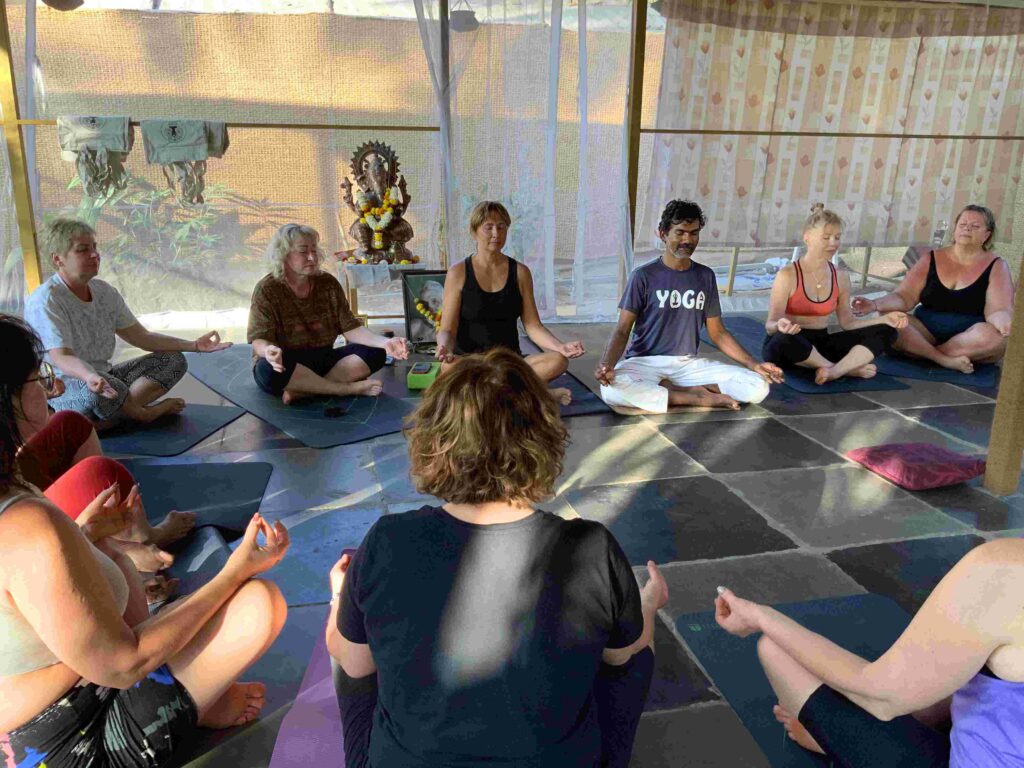
For International Yoga Day this year, that attention was the point. Rather than a single large demonstration, the day at Ruban Yoga unfolded as it normally does, just with a little more intention woven through it. Morning classes began at the usual early hour, with an extended Hatha session that focused on joint mobility, breath work, and the kind of slow, deliberate movement that serves a body at any age but matters enormously as that body gets older. Ruban worked his way around the mats individually, adjusting a knee that had drifted out of alignment in Warrior, softening a spine that had rounded too far forward in a seated fold. This is the kind of correction that rarely makes it into a photograph but is the entire reason a practice stays sustainable over decades rather than causing the very injuries it is meant to prevent.
Sound as Medicine, Not Decoration
There is something fitting about pairing a celebration of healthy ageing with the solstice itself. June 21 carries the most daylight of any day in the year, and in many contemplative traditions, the solstice is treated as a hinge point. Energy peaks and then, slowly, begins to turn. It is not a coincidence that this same day was chosen, all the way back in 2014, as the moment to anchor a global yoga observance.
At Ruban Yoga, the solstice was marked simply, with a longer practice that ran from the early light of morning through into a midday session, deliberately built to use as much of the extended daylight as the day offered. No part of it was rushed. The pace itself was a quiet argument for the year’s theme. Healthy ageing is not about doing more in less time. It is often about doing less, but doing it with far more attention.
A Small Studio’s Answer to a Global Theme
What made the day at Ruban Yoga meaningful was not its scale. It was the opposite. While government sponsored events drew thousands to monuments and city squares across India, a handful of people on a quiet beach in South Goa spent the day proving the same point in miniature: that yoga’s real power has never come from the size of the crowd practicing it. It comes from whether the person on the mat is actually being seen, corrected, and supported.
This is the founding idea behind Ruban Yoga itself, a small, soulful space built deliberately in reaction to the bigger, more performance driven studios that have come to define yoga’s public image in recent years. Class sizes are kept small on purpose. Teacher training groups are capped so no student becomes just a face in a crowd. For a theme built around the idea that yoga should serve a person across every stage of life, that philosophy is not just compatible. It is close to essential. A sixty five year old working through stiff hips needs a teacher who notices when a posture is causing strain, not one calling out the next pose from the front of a packed room.
Carrying It Forward
International Yoga Day will come again next June, with a new theme and, almost certainly, even larger official numbers attached to it somewhere in the world. But the version of the day that unfolded at Ruban Yoga this year offers a useful reminder for anyone who was not standing in a stadium or in front of a monument.
You do not need a hundred cities or a record breaking UN resolution to participate in what this day is actually about. You need a mat, a little daylight, and ideally someone paying close enough attention to tell you when your knee has drifted past your ankle. Whether that happens on a beach in Goa, in a quiet room at home, or anywhere else a person decides to show up for their own body, the spirit of the day travels with it.
Sand, sound, and solstice were simply the form it took this year at Ruban Yoga. The substance, attention, breath, and the long, unglamorous work of ageing well, is available every single day of the year, to anyone willing to come back to the mat.